 St. Petersburg Siding
 Why Decks Fail Faster on St. Pete Beach
A deck on St. Pete Beach lives a harder life than one a few miles inland. This is a barrier island — salt-laden air moves across the property every day, humidity stays high most of the year, and afternoon storms bring wind-driven rain that gets up underneath railings and into joints that a typical deck design never accounts for. Add in the intense, nearly year-round Florida UV load, and you have three separate forces working against the structure at once: corrosion, moisture, and material breakdown from sun exposure.
None of these forces are dramatic on their own. A deck rarely fails in one storm. Instead, fasteners slowly corrode, connections loosen, wood fibers gray and split, and framing members lose strength a little at a time until a routine inspection — or a soft spot underfoot — reveals how much damage has actually accumulated. By the time a deck looks visibly bad, the structure underneath is usually further along than the surface suggests.
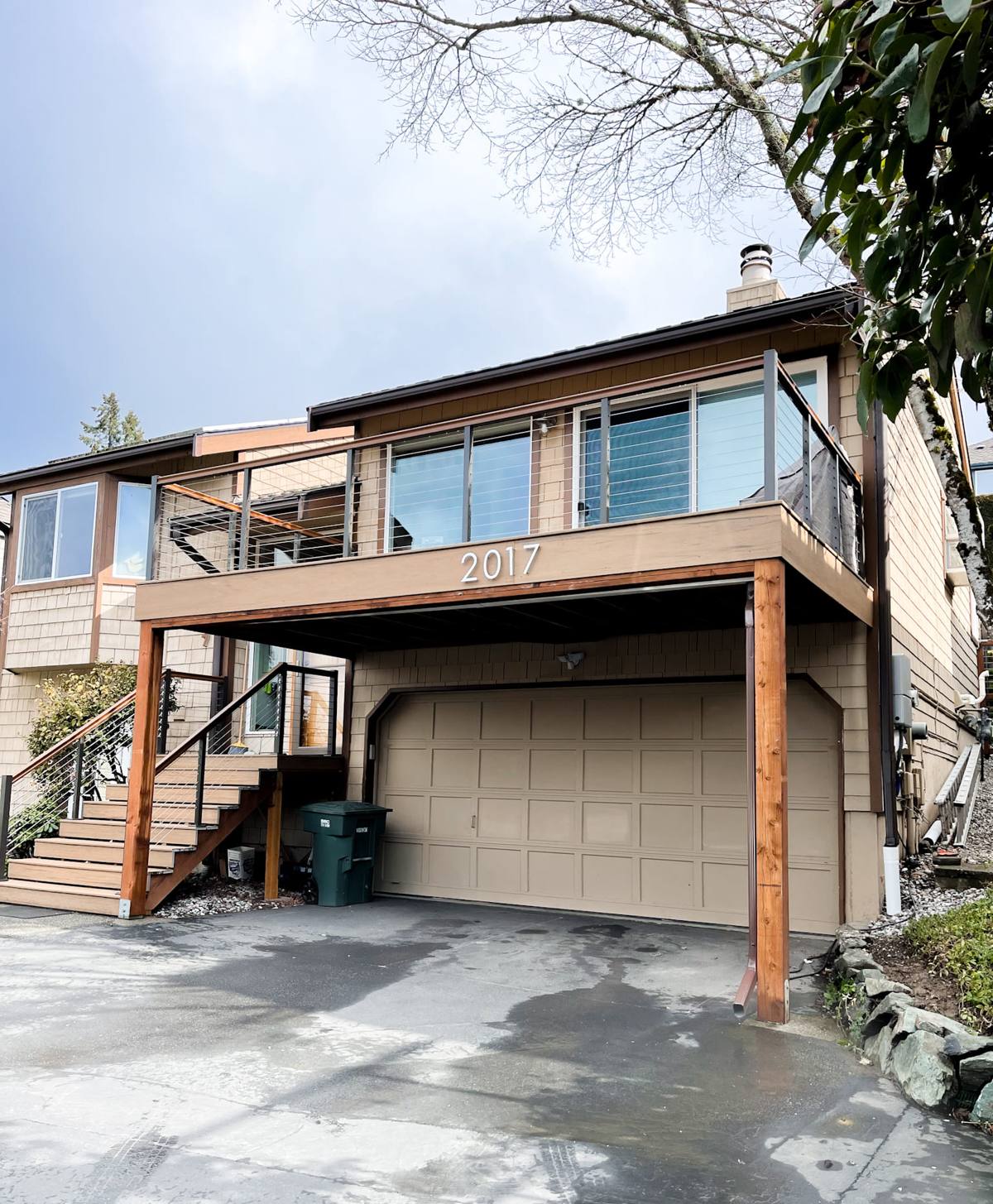
Signs a Deck Needs Replacement, Not Repair
Not every aging deck needs a full teardown. But there's a point where patching boards or sistering a joist is just delaying a bigger job — and spending money on materials that won't outlast the structure they're attached to. A few boards can often be repaired. Framing, connections, and footings are a different story.
- Soft, spongy, or bouncy spots when you walk across the deck
- Rust streaks or corroded fastener heads, especially around joist hangers and ledger bolts
- Wood that's gray, splintering, or checking (splitting) along the grain
- Railings that wiggle or posts that feel loose at the base
- Gaps opening up between the ledger board and the house
- Visible rot at ground contact points, post bases, or stair stringers
- A deck older than 15-20 years that has never had framing inspected
- Any deck built before current wind-load and connection standards were common practice
If you're seeing two or more of these, it's worth having someone look at the framing before deciding what the project actually needs.
Building to Florida Code on a Barrier Island
Decks in St. Petersburg and on St. Pete Beach are governed by the Florida Building Code, and construction this close to the water carries a few extra considerations that inland projects don't deal with. Depending on the property's location, that can include coastal construction line review, flood zone requirements, and wind-load provisions that call for stronger connections between the deck and the house, between posts and footings, and between railings and framing than older decks were ever built with.
Pinellas County and the local building department require permits for deck replacement work, and for good reason — the inspection process catches the exact failure points that cause decks to come apart in a storm: ledger attachment, joist hangers, post-to-footing connections, and guardrail strength. We pull permits and build to pass inspection, not to get by until the inspector leaves. On a barrier island property, skipping that process isn't a shortcut worth taking.
What This Means in Practice
In real terms, a code-correct deck replacement here means proper flashing at the ledger board so water can't get trapped against the house, hot-dip galvanized or stainless connectors rated for coastal exposure, footings sized and set to local frost-free and load requirements, and railing systems built to resist lateral loads — not just decorative-looking rail that flexes when leaned on.
Choosing the Right Decking Material
There's no single "best" decking material for every home — it depends on budget, how much maintenance you want to do, and how close the deck sits to salt spray. Here's how the common options actually compare in this climate.
| Material | How It Handles Salt Air & UV | Maintenance | Typical Lifespan Here |
|---|---|---|---|
| Pressure-treated pine | Needs sealing to resist moisture and graying; fasteners must be coastal-rated to avoid galvanic corrosion | Annual cleaning, resealing every 1-2 years | 10-15 years with upkeep |
| Composite decking | Resists moisture and UV fading well; doesn't splinter or rot | Periodic washing, no sealing or staining | 20-25+ years |
| PVC/capped polymer | Fully sealed surface, strong resistance to salt, moisture, and sun | Low — occasional washing | 25+ years |
| Tropical hardwoods | Naturally dense and moisture-resistant, but sensitive during installation and can check in intense sun without care | Regular oiling to maintain appearance | 20-25 years with diligent care |
We install pressure-treated and composite decking most often on St. Pete Beach projects because they give homeowners a clear, honest tradeoff: lower upfront cost with more upkeep, or higher upfront cost with decades of lower-maintenance performance. We'll walk through the real difference in your specific situation rather than pushing whatever's easiest to install.
A Note on Hardware and Fasteners
Whatever decking material you choose, the fasteners and structural connectors matter just as much — arguably more, since they hold the whole structure together. Standard galvanized hardware degrades faster in salt air than most homeowners expect, and mixing incompatible metals (like standard steel screws with aluminum flashing) can actually accelerate corrosion through a galvanic reaction. We spec stainless steel or coated coastal-rated fasteners and connectors on every St. Pete Beach deck, because replacing decking boards in ten years is a much smaller job than replacing decking boards and re-framing because the hardware failed first.
Framing: The Part No One Sees Until It Fails
The boards you walk on are the least of what determines whether a deck lasts. The framing underneath — ledger board, joists, beams, and posts — is what actually carries the load, and it's almost always pressure-treated lumber even under composite or PVC decking. In this climate, framing failures typically start in a few predictable spots: where the ledger meets the house (if flashing wasn't installed correctly), at joist hanger connections (if fasteners have corroded), and at post bases where standing water or soil contact accelerates rot.
When we replace a deck, we don't just swap the surface boards and call it done. We evaluate the framing, ledger attachment, and structural connections as part of the same project, because a new deck surface on failing framing is a short-term fix that creates a bigger repair later.
Footings and Foundations in Sandy Coastal Soil
Soil on St. Pete Beach and much of the surrounding barrier island area tends to be sandy, which behaves differently under load than the denser soils inland decks are often built on. Footings need to be sized and set to the correct depth to stay stable, and post connections need to resist both uplift (from wind) and lateral movement — not just carry weight straight down. This is one of the areas where cutting corners doesn't show up right away; it shows up years later as a deck that starts to rack, lean, or separate from the house during a windy season.
Our Deck Replacement Process
We keep the process straightforward and predictable, because the last thing a homeowner needs during a home project is uncertainty about what's happening next.
- On-site evaluation. We inspect the existing deck's framing, ledger connection, footings, and overall condition, and talk through what's driving the need for replacement.
- Material and design discussion. We go over decking material options, railing style, and layout, with honest pros and cons for each based on your budget and how the space gets used.
- Permitting. We handle the permit application and coordinate required inspections with the local building department.
- Demolition and disposal. The old deck comes out, including any compromised framing, and debris is hauled off site.
- Framing and structural work. New or reinforced framing, properly flashed ledger attachment, and coastal-rated connectors go in first — this is the part that determines how the deck performs in year 10, not just year one.
- Decking, railing, and finish work. Surface decking, railing systems, and stairs are installed to code and to the design you approved.
- Final inspection and walkthrough. We pass the required inspection and walk the finished deck with you before calling the job complete.
Maintenance That Actually Extends the Life of a Coastal Deck
A well-built deck still needs some ongoing attention in this environment. A little consistency goes a long way toward avoiding an early replacement.
- Rinse salt residue and debris off the decking surface periodically, especially after storms
- Keep gutters and drainage clear so water isn't dumping directly onto or under the deck
- Check railings and stair connections for looseness once or twice a year
- Reseal pressure-treated wood on the manufacturer's recommended schedule — don't stretch it
- Watch for standing water pooling under the deck near posts and footings
- Have framing and connections checked periodically rather than waiting for a visible problem
Why Local Experience Matters on This Job
Deck replacement is one of those projects where the difference between a crew that works St. Pete Beach regularly and one that doesn't shows up in the details: knowing which fasteners actually hold up against salt air instead of just meeting a generic spec, understanding the local permitting and coastal construction requirements, and recognizing how sandy soil and wind exposure change footing and framing decisions. Pinellas County's coastal conditions aren't a footnote here — they're the reason a deck built the same way as one in a drier, inland climate tends to fail sooner. We build for the environment the deck actually lives in, not a generic version of Florida.
If your deck is showing its age, feels less solid than it used to, or you're just ready to plan a replacement before a small problem becomes a bigger one, we're happy to take a look. Fill out the form below for a free, no-pressure estimate — we'll walk the deck with you, explain what we see, and give you a straight answer on what it needs.