 St. Petersburg Siding
 What LP SmartSide Actually Is
LP SmartSide is an engineered wood siding product made from wood strands bonded with resin under heat and pressure, then coated with a proprietary treatment called SmartGuard that's designed to resist fungal decay and moisture absorption at the strand level. It's manufactured to look like traditional wood lap siding, board-and-batten, or shakes, and it comes primed and ready for field paint. It is fundamentally a wood-based product engineered to perform better than old-school untreated wood siding — and by that measure, it does.
We get asked about it often enough that it's worth a straight answer: we don't install it. Not because it's a bad product in the abstract, but because after weighing how it performs against what a Pinellas County home actually goes through year after year, we decided we couldn't stand behind it the way we can stand behind fiber cement. This page explains that reasoning honestly, including what LP SmartSide does well.
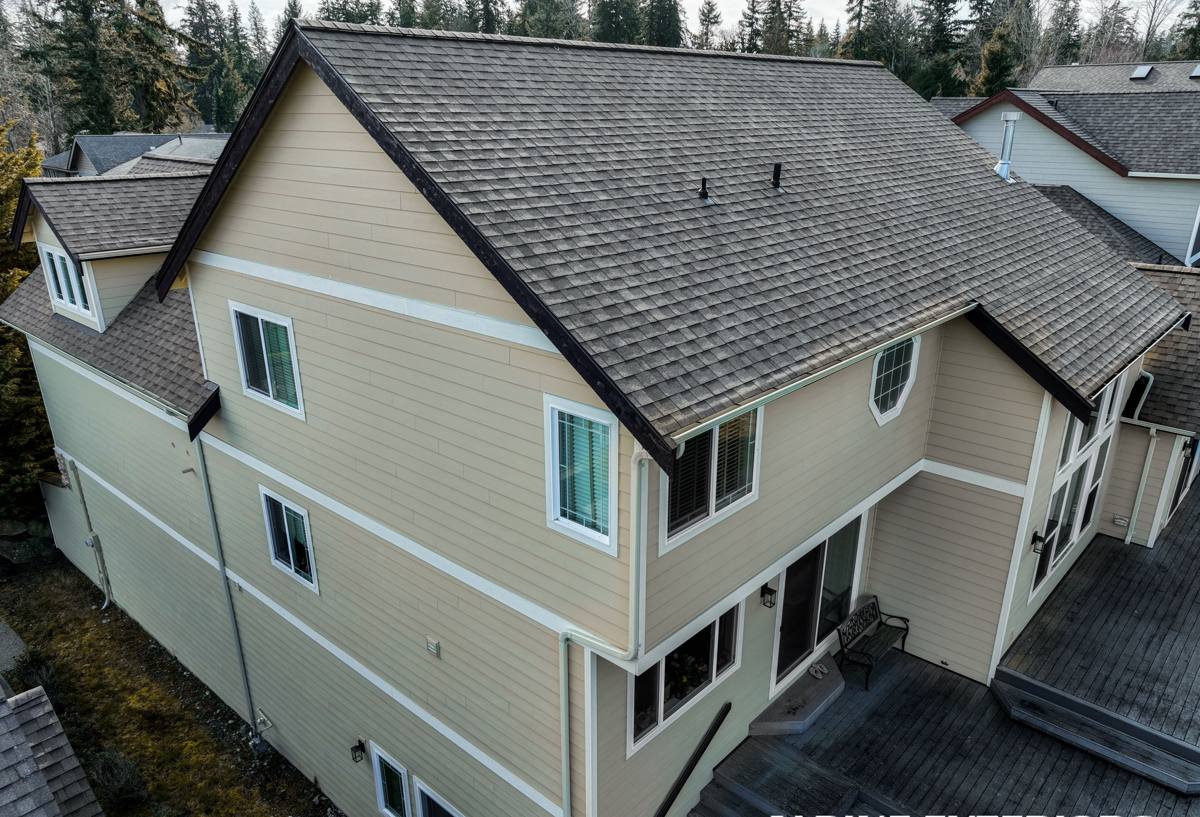
What LP SmartSide Gets Right
Credit where it's due. Compared to raw dimensional wood or unfinished cedar, LP SmartSide is a real improvement:
- The resin-saturated strand construction is more dimensionally stable than solid wood, so it resists cupping and splitting better than old cedar lap siding.
- SmartGuard treatment penetrates the substrate rather than just coating the surface, which helps resist fungal decay compared to untreated wood.
- It's lighter than fiber cement, which can make handling and cutting on-site somewhat faster.
- It takes paint well and can achieve a wood-grain look that some homeowners prefer over the smoother finish of fiber cement.
If a homeowner specifically wants that traditional wood-plank aesthetic and understands the maintenance commitment, LP SmartSide is a legitimate step up from real wood. Our concern isn't that it's a scam product — it's that it's still an engineered wood product, and wood, even engineered wood, behaves differently than fiber cement once it's on a house near the Gulf.
Why Wood-Based Substrate Matters on the Gulf Coast
St. Petersburg sits in a climate that's rough on any exterior material: high year-round humidity, intense UV exposure nearly twelve months a year, wind-driven rain during summer storms, and a steady dose of salt-laden air off Tampa Bay and the Gulf. Every siding product sold nationally has to survive that combination here, even though most of them were engineered and tested for drier, milder climates elsewhere in the country.
Engineered wood siding's core vulnerability is still wood chemistry. Wood strands, no matter how well they're bonded and treated, absorb and release moisture with humidity swings. That expansion and contraction cycle is slower and more controlled than in solid lumber, but it doesn't disappear — it's managed, not eliminated. In a climate where the relative humidity rarely drops and afternoon storms are a near-daily summer occurrence, that moisture cycling happens more often and more aggressively than in the drier regions where a lot of engineered wood siding performance data was originally generated.
Fiber cement, by contrast, is made from cellulose fiber, sand, and portland cement — an inorganic-dominant composition that simply doesn't swell, rot, or feed fungal growth the way any wood-based product can, treated or not. That's the core material difference driving our decision, and it matters more here than it would in Denver or Minneapolis.
The Moisture and Edge-Sealing Problem
The single biggest factor in how any engineered wood siding performs long-term is what happens at the cut ends, corners, and seams — the places where the factory treatment has been sawn through and the raw substrate is exposed. Manufacturers require field-applied sealant on every cut edge, every fastener penetration, and every joint, without exception. Miss one spot and you've created a moisture entry point that can go undetected for years before it shows up as soft spots, swelling, or bubbling paint.
In a climate with wind-driven rain events during hurricane season, siding takes on water horizontally, not just from above. Any unsealed or under-sealed edge on a wood-based panel is a liability during a tropical storm passing through Pinellas County in a way it simply isn't in a low-rainfall region. We've found that edge-sealing discipline is one of the easiest steps for any crew to shortcut under time pressure, and the consequences don't show up on inspection day — they show up two or three humid seasons later.
Fiber cement isn't immune to poor installation either, but because the material itself doesn't absorb and swell with moisture the way wood does, a missed sealant spot is far less consequential. That gap in forgiveness is a big part of why we don't install products where correct execution has to be perfect at every single cut, every time, for the life of the product.
Installation Sensitivity: A Side-by-Side Look
Both products require competent installation, but the margin for error is different. Here's how the two compare on the details that actually determine long-term performance:
| Installation Factor | LP SmartSide (Engineered Wood) | James Hardie (Fiber Cement) |
|---|---|---|
| Cut-edge treatment | Every field cut must be sealed with manufacturer-approved primer/sealant, no exceptions | Factory-cured material; less sensitive to unsealed field cuts |
| Moisture response | Can swell or lose integrity if edges are compromised over time | Non-combustible, does not absorb moisture into a swelling substrate |
| Fastener requirements | Specific nail type, spacing, and penetration depth to avoid splitting or moisture wicking | Specific nail type, spacing, and clearance per HardieZone requirements |
| Clearance from grade/roofline | Manufacturer minimum clearances to limit splashback moisture | Manufacturer minimum clearances, less consequential if occasionally tight |
| Paint/finish maintenance | Field-painted or factory-primed; repainting cycle needed to maintain the protective layer | ColorPlus factory finish baked on, warrantied separately from the substrate |
The pattern across every row is the same: engineered wood siding demands more precision at more points in the install, and the cost of getting any one of those points wrong is higher because the substrate itself can be affected. That's a lot of responsibility to put on a crew working a full day of siding installs in summer heat.
Warranty Structure Considerations
LP SmartSide's warranty is a legitimate, transferable product warranty, and LP stands behind it. But like most engineered wood warranties, it typically requires documentation that installation followed the manufacturer's specifications exactly — including edge sealing, fastening, clearances, and finish maintenance schedule. If a claim comes down to whether a cut edge was properly sealed six years ago, that's a hard thing for a homeowner to prove either way, and it puts the burden of proof on the person least equipped to carry it.
We prefer standing behind a product where the warranty conversation is simpler and the material itself carries less of that installation-dependent risk. That's a business judgment as much as a technical one, but it's one we've made deliberately after looking at how warranty claims tend to actually play out on wood-based products in a humid climate.
Hurricane Wind and Storm Exposure in Pinellas County
Pinellas County homes are built to a wind-load standard that reflects real hurricane risk, and siding is part of that envelope. Wind resistance for lap siding comes down to fastening pattern, panel engineering, and how the product handles repeated flex and pressure cycling during a storm, not just peak wind speed on a spec sheet. LP SmartSide is engineered to meet code wind-load requirements when installed correctly, and so is Hardie. The difference we weigh more heavily is what happens after the wind event — during the days or weeks of elevated humidity and standing moisture that typically follow a Gulf Coast tropical system, when any compromised seal or exposed edge is under the most stress it will see all year.
Salt air adds a slower, quieter version of the same story. It's not itself an eroder of these siding materials the way it is with untreated metal, but combined with UV exposure and humidity, it contributes to the general wear cycle every exterior surface faces this close to the water.
Why We Standardized on James Hardie Instead
After weighing these factors across enough homes, we made fiber cement — specifically James Hardie — our standard, and we don't install alternatives including LP SmartSide, vinyl, Cemplank, Allura, primed spruce, or cedar. A few reasons drove that:
- Non-combustible material — fiber cement doesn't burn, which matters for insurance conversations as much as safety.
- Climate-engineered product lines — Hardie's HZ5 formulation is specifically engineered for high-humidity, high-moisture climates like ours, not a general national product adapted after the fact.
- ColorPlus factory finish — a baked-on finish with its own dedicated warranty, reducing how much of the long-term appearance depends on a repaint cycle.
- Substrate that doesn't swell — the moisture-cycling risk that drives most of our concerns with engineered wood simply isn't present in the same way.
- A track record we can stand behind — when we install one product to one exacting standard, our crews get better at the details that actually matter over time, instead of splitting attention across product lines with different sensitivities.
None of this means every LP SmartSide installation is destined to fail — plenty perform fine when installed meticulously and maintained on schedule. It means that when we compared the realistic long-term risk profile against a climate as demanding as St. Petersburg's, fiber cement was the product we were willing to put our name behind.
Cost Factors to Weigh
Upfront material and labor cost is one piece of the decision, but it's not the whole picture. Here's a broad, honest comparison of what tends to drive total cost of ownership over time:
| Cost Factor | LP SmartSide | James Hardie Fiber Cement |
|---|---|---|
| Typical installed cost | Generally moderate, often less than fiber cement per square foot | Generally higher upfront than engineered wood |
| Repainting cycle | Needed on the interval recommended for the finish system chosen | ColorPlus finish extends time before repainting is needed; primed Hardie still needs painting on a normal cycle |
| Edge-sealing maintenance | Homeowner should periodically inspect and re-seal any exposed cuts or damage | Lower ongoing sensitivity to minor cut exposure |
| Insurance considerations | Varies by carrier; combustible material classification | Non-combustible classification can factor into some insurance discussions |
| Expected service life when installed to spec | Long, contingent on maintenance discipline | Long, less contingent on ongoing maintenance discipline |
Questions Worth Asking Before You Choose
Whatever siding you're considering for a St. Petersburg home, these are the questions worth getting straight answers to before signing a contract:
- Does the installer follow the manufacturer's edge-sealing and fastening spec on every single cut, and how do they verify it?
- What is the manufacturer's climate zone rating for this product, and was it engineered for Gulf Coast humidity or adapted from a national spec?
- What voids the warranty, and who carries the burden of proof if a claim comes up years later?
- What is the realistic repaint or refinish interval, and what does that cost over a 20-year horizon?
- Is the product rated for the wind load and impact requirements specific to Pinellas County's building code?
If you're weighing your options for a siding replacement or new install anywhere in St. Petersburg or the surrounding Pinellas County area, we're happy to walk your home, explain what we see, and give you a straightforward, no-pressure estimate for James Hardie fiber cement siding — no obligation, just an honest look at what your house needs.