 St. Petersburg Siding
 Building a Deck That Can Handle Pinellas Point's Waterfront Climate
Pinellas Point sits at the southern tip of St. Petersburg, surrounded on multiple sides by open water — Tampa Bay to the east, Boca Ciega Bay to the west. That location is exactly why homes here need to think harder about outdoor living space than homes further inland. A deck built with the wrong materials, or built correctly but with the wrong details, doesn't fail gracefully in this environment. It fades, cups, corrodes, or comes loose faster than the homeowner expects, usually within a few seasons rather than a decade.
Composite decking exists specifically to solve the problems that wood struggles with, but "composite decking" isn't one product with one performance level. The board itself, the substructure underneath it, and the hardware holding it together all matter — and in a place with the kind of sun, humidity, and storm exposure Pinellas Point gets, cutting corners on any one of those shows up early. This page walks through what a deck in this neighborhood actually needs, what a correct installation looks like, and how we approach the job.
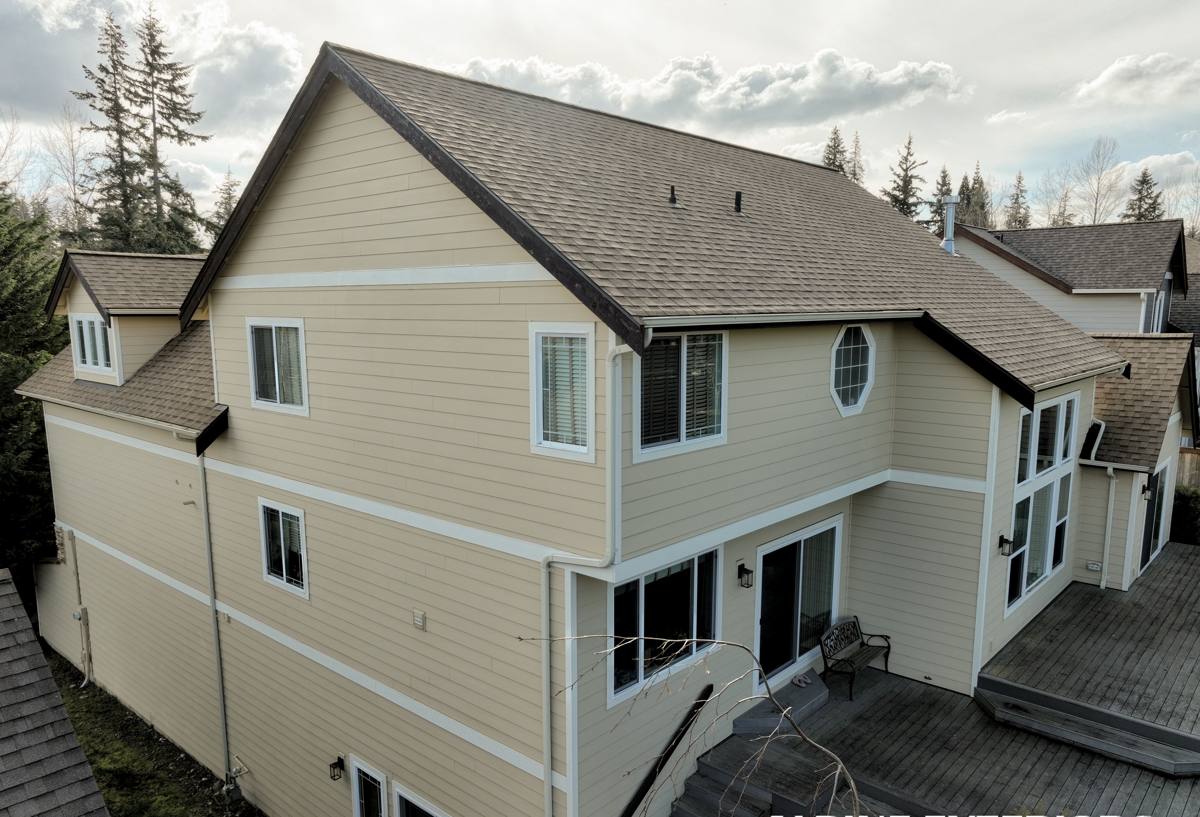
What Sun, Salt Air, and Storms Do to a Deck Here
Every material choice on this page traces back to the same handful of stressors. Understanding them is the difference between a deck that looks new in year eight and one that looks tired by year three.
Year-Round UV
Central Florida doesn't get a real off-season for sun exposure. Boards facing south or west take a steady beating from UV year-round, which is what causes cheap composite decking to fade unevenly, chalk on the surface, or go brittle at the edges. Uncapped or lower-grade composite boards are far more prone to this than fully capped products.
Salt Air and Corrosion
Being close to Tampa Bay and the Gulf means salt-laden air moving across the property even without a direct waterfront lot. Salt air accelerates corrosion on anything metal — screws, joist hangers, post bases, railing brackets. A deck can look fine on the surface while the fasteners holding it together are quietly rusting away underneath.
Wind-Driven Rain and Storm Exposure
St. Petersburg sits in a hurricane-exposed part of the Gulf Coast, and Pinellas County sees its share of tropical systems and strong summer thunderstorms with wind-driven rain. That combination pushes water sideways into fastener holes, ledger connections, and gaps that would stay dry in a milder climate. Decks here need drainage and attachment details built for water coming from the side, not just from above, plus a structure that can take real wind load without racking or loosening over time.
Composite, Wood, or PVC: What Actually Holds Up
We install composite decking because, for most Pinellas Point homeowners, it hits the right balance of durability, appearance, and reasonable upkeep in this climate. That doesn't mean every material is a bad choice — it means each one comes with real trade-offs worth understanding before you commit.
| Factor | Pressure-Treated Wood | Composite Decking | PVC / Cellular |
|---|---|---|---|
| Upfront cost | Lowest | Mid-range | Highest |
| Salt-air / humidity resistance | Poor without diligent upkeep | Strong, especially capped boards | Very strong |
| UV fading over time | Grays and splinters | Minimal on capped products | Minimal |
| Maintenance burden | Annual sealing/staining | Occasional washing | Occasional washing |
| Heat underfoot (dark colors) | Moderate | Can run warm in direct sun | Can run warm in direct sun |
| Typical warranty structure | None from lumber itself | Manufacturer-backed, often prorated | Manufacturer-backed, often longer |
Wood costs less to buy but demands the most upkeep — annual sealing or staining is the price of keeping it from graying and splitting in this humidity, and skipped maintenance shows fast. PVC performs excellently but costs more up front, and some homeowners find the look less natural. Composite, particularly a fully capped board, lands in the middle: a wood-look surface that doesn't need yearly sealing and holds up well against salt air and sun when it's installed correctly.
What a Correct Composite Decking Installation Involves
The board is only part of the job. Most composite deck problems we get called to fix trace back to what's underneath the boards, not the boards themselves.
Framing and Substructure
Composite decking is heavier than wood decking, and it's less forgiving of an undersized or improperly spaced substructure — boards can sag or feel spongy over time if joist spacing wasn't tightened up for the specific product being installed. Framing lumber should be rated for ground contact or coated appropriately, since it's the part of the structure most exposed to trapped moisture.
Fasteners and Hardware
Given how aggressively salt air corrodes standard fasteners here, every screw, hanger, and bracket needs to be rated for coastal or corrosive environments — not just "exterior grade." This is one of the most common shortcuts we see on older or budget decks in this area, and it's almost always the first thing to fail.
Ledger Attachment and Waterproofing
Where the deck ties into the house is the single most important connection on the structure, both for keeping the deck attached in high wind and for keeping water out of the house framing. That connection needs proper flashing and waterproofing, not just lag bolts driven into siding or sheathing.
Drainage and Airflow Underneath
Composite boards need a gap for water to escape and air to circulate underneath. Without it, moisture sits trapped against the substructure — which, combined with Florida humidity, is exactly the setup that rots framing lumber and corrodes hardware years before the composite decking itself would ever wear out.
Wind, Railings, and Local Requirements
Coastal Pinellas County properties are subject to real wind-load expectations, and that shows up most in railing attachment and post connections — the parts of a deck that take the most lateral force in a storm. A correctly built deck accounts for uplift and lateral loads in how posts are anchored and how railings are fastened, not just how it looks. Depending on your lot's elevation and flood zone designation, there can also be specific requirements around deck height or attachment to the home that a local permit review will flag. We pull permits and build to what the local building department requires for your specific property rather than treating every lot the same.
Our Process, Start to Finish
- On-site assessment — we look at your existing structure (if replacing a deck), sun exposure, drainage, and how the space is actually used.
- Material walkthrough — honest comparison of composite options and price points, no pressure toward the most expensive board.
- Written estimate — a clear scope covering substructure work, fasteners, decking, railings, and permitting.
- Permitting — we handle the permit process with the local building department before work starts.
- Demolition and substructure build or repair — done to hold up under coastal wind and moisture, not just meet minimum code.
- Decking, railing, and finish work — installed with corrosion-rated hardware and proper spacing for expansion and drainage.
- Final walkthrough — we go over the finished deck with you before calling the job done.
Maintaining Composite Decking in a Salt-Air Climate
One of the appeals of composite decking is how little it asks of you compared to wood, but "low maintenance" isn't "no maintenance," especially this close to the water.
- Rinse or hose off the deck periodically to clear salt residue, pollen, and debris before it builds up in board grooves.
- Wash with soap and water a couple of times a year to prevent mildew, which grows readily in Florida humidity.
- Check railing posts and fastener points annually for any looseness — a five-minute check that catches problems early.
- Keep gutters and drainage paths near the deck clear so water isn't pooling against the structure after storms.
- Trim back landscaping that shades boards constantly, since trapped moisture under foliage is a common spot for mildew to take hold.
Why Hire a Crew That Already Works Pinellas Point
A deck built for a subdivision twenty miles inland and a deck built for a lot exposed to Tampa Bay's salt air shouldn't be built the same way, even if the homeowner picks the same composite board. A crew that regularly works Pinellas Point and the rest of St. Petersburg already knows which fastener grades hold up here, how the local building department wants ledger and railing connections detailed, and where drainage tends to be a problem on this kind of terrain. That familiarity shows up in fewer surprises during the build and a deck that's still solid well past the point where a corner-cut version would be showing rust stains and loose railings.
Let's Talk About Your Deck
If you're weighing composite decking for a home in Pinellas Point or anywhere else in St. Petersburg, we're happy to walk the property, talk through material options honestly, and give you a straightforward estimate — no pressure, no sales script. Fill out the form below and we'll get in touch.